
Walking the tightrope
Working in higher education often feels like walking a tightrope between two worlds: the academic and the operational. On paper, the distinction seems clear, with strategy at the top and delivery on the ground. In practice, these worlds overlap constantly, and even the best intentions can create friction in ways no one expects.
So many times I have heard these differentiated by the hands on and the hands off, and with that in mind you may already get a sense of the tensions this brings to the temples of many senior leaders and managers when there is a standoff between the overlapping areas or responsibility, accountability, and the genuine realities of implementing theoretical works in the day to day.
The butterfly effect of decisions
Small decisions can have surprisingly large ripple effects. Implementing a new policy might appear straightforward, but legacy processes, entrenched behaviours, or simple misunderstandings can create a cascade of operational challenges.
Policy and procedure both is, and isn’t, an academic piece of work, in the sense that often procedure comes first, and there is (usually!) a stakeholder consultation where the current practices are reviewed and absorbed by the policy writer, and then formed into a document which articulates the step by step of how to deal with the scenario, and contingencies within the scope of it. For example, what is wellbeing support by definition, how o you identify kt what is available, who does it, how long does it take to do that typically, who is responsible, accountable, and what if there are other factors or policies that should be considered in those circumstances etc. and typically the operational work prescribes the majority of the policy, and the policy formalises it in the context of responsibilities. A tweak in curriculum or assessment can influence timetabling, staffing, and student support in ways that no single policy document can anticipate, and there itself is a key area that needs integration and consultation before firming up a policy and process.
Finding the hands-on hands-off balance
There is more than one way to skin a cat, and in leadership there are different strengths and skills that leaders hold which shape their approaches to solve problems. In the day to day, consultants do this through engaging in discourse, and documentation, and AI has transformed the problem solving attitudes of businesses and consultants alike, enabling quick synthesis of information and operational documentation, governance and otherwise to inform processes.
However, back to the intiial points, this should be a reflection of the operational processes, and the consultation process and content is critical to the hand on stakeholders to know that they are in fact delivering or deviating from the process. This often comes with training following the policy or procedural formalisation, but whether due to the ease of AI generation, or by a separation of the hands off-hands-nn approach, it is sometimes difficult to bridge and agree.
Leaders in positions that can shape the way people do things need to find the right balance between being hands-on and hands-off. Step back too far and you risk losing sight of knock-on effects. Dive in too deeply, and you may stifle your team’s autonomy and become so operationally focused that you loose stouch with the strategic planning and reasons you need to streamline the process in the first place.
The sweet spot is being present enough to anticipate friction points while trusting your teams to execute the details with expertise, and properly engaging with stakeholders to understand the realities of the day to day world, and helping to translate the rationale and formalisation to them.
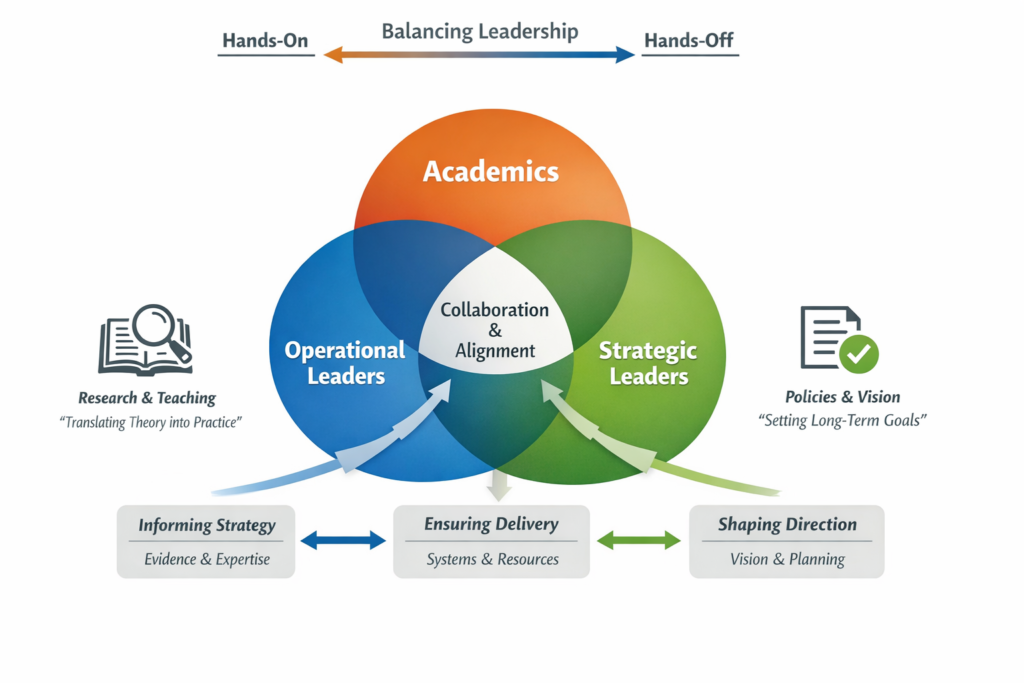
Legacy behaviours, role stereotypes and frameworks
Higher education organisations carry a legacy of academic prestige, and there are long standing perceptions of what an academic is and does, and there is a historical archive of philosophy and academic literature that captures that essence much more concisely that I could, and you can look into Marcus Aurelius (Stanford Encyclopedia of Philosophy) for that. However in the same breath, let’s have a think about what that means strategic delivery and leadership in this context.
Academics
Without diving too deep, Academics are often stereotyped as research-focused intellectuals, spending their time lecturing, debating theory, or navigating committees, conferences, or writing papers for publication. The reality is most academics juggle research, teaching, mentoring, and administrative responsibilities, translating theory into practice, collaborating with colleagues and discussing pedagogy and assessments, they supporting students through a variety of academic and pastoral issues, and deliver the academic experience. While they value intellectual freedom, they also work within teams and structures, making decisions that influence both academic and operational outcomes.
Operational Leaders
Operational leaders are often stereotyped as process-driven administrators, focused on rules, paperwork, and efficiency, sometimes perceived as rigid or lacking strategic insight. In reality, their role is dynamic and multifaceted and most operational leaders manage systems, teams, and resources while enabling academic priorities and taking into account continual feedback and complaints, solving practical problems, managing the day to day while having a long term vision of efficiency and ensuring that strategy is delivered effectively and there is a measurable output or success. They collaborate across the institution, anticipate friction points, and translate high-level goals into tangible outcomes, all while supporting staff and students and keeping operations running smoothly.
Strategic Leaders
Strategic leaders are often seen as visionaries, focused on long-term goals, institutional reputation, and big-picture initiatives. The stereotype paints them as distant from day-to-day realities, spending their time in meetings, planning committees, or producing strategic documents. The reality is more nuanced. Effective strategic leaders must understand the practical implications of their decisions, anticipate how policies will affect both staff and students, and ensure that strategy is actionable. They balance foresight with responsiveness, providing direction while supporting operational and academic teams to implement initiatives effectively. They communicate and intergrate, both managing and understanding the implications of change in the workplace.
Overlapping Roles
The boundaries between academics, operational leaders, and strategic leaders are not fixed and they constantly overlap. Strategic leaders rely on academics to translate vision into research, teaching, and student outcomes. They depend on operational leaders to design and maintain systems that make implementation possible. Similarly, academics and operational leaders often contribute to shaping strategy through feedback, evidence, and insight from the frontline they are constantly . The most effective leadership occurs when these roles communicate, collaborate, and recognise their interdependence. You may get a flavour of my style of leaddership and ways of working from reading this, but in my eyes these are key traits of the transformational and distributed leadership models. More on that in other blogs.
Strategy guides operations and academics, operations enable strategy and academic work, and academics inform strategy and operational priorities, creating a continuous cycle where all three reinforce each other.
Integrating new roles and responsibilities
With this in mind, without integration in these areas to stabilise and distribute responsibilities, it can amplify existing frictions and expose weaknesses in both the leaderships skills, and the operational resourcing on the ground.
Even with a clear strategy, gaps in communication or unclear accountability can undermine progress, and i have experienced this first hand when leaders lean heavily on putting a wall between academic and operational responsibilities. It becomes very revealing, particularly for the intergrated practitioner.
Perhaps the most subtle tension is between perception and reality. Those enacting operational leadership understand the nuances of delivery that strategy documents rarely capture. Adjustments and compromises happen daily, and what looks like deviation from strategy is often a pragmatic response to real-world constraints. Oftentimes in younger companies, the documentation is a slick and simple 1 page training documents, or verbal training, which becomes more complex over time and growth, and of course needs an experienced approach to consolidate, and becomes a translation exercise.
Using frameworks and reflection to guide integrated leadership
Structured frameworks, true reflection, (and in would say above all practical experience of navigating this in practice) can help leaders navigate this complexity. The Advance HE Framework for Leading in Higher Education, for example, encourages reflection on how personal leadership style aligns with institutional priorities. It supports understanding when to be hands-on and when to step back, and it promotes inclusive and distributed leadership across academic and operational domains (Advance HE leadership framework).
Reflective practice is a powerful tool for leaders trying to integrate academic, operational and strategic perspectives. Qualifications or reflective application routes like those from the Chartered Management Institute (CMI) embed reflection as a core component of leadership development, helping learners review their decisions, behaviours and impact in real contexts. For example, the CMI Level 5 and Level 6 qualifications include specific units on using reflective practice to inform personal and professional development, encouraging learners to analyse their own performance and identify areas for growth. The chartered route also offers this through interview enquiry and is a form of lifelong learning and professional development, and a standard of excellence across the HE sector.
Connecting strategy and delivery
Leadership in higher education is not about separating strategy from delivery. It is about connecting them. Strategic decisions only gain impact when they are integrated into operational realities with accountability, transparency, and trust. Academic and operational leadership are not opposing forces. They are two sides of the same coin, each essential to the other. Strategy sets the direction, and operations shape how that direction is realised. When leaders navigate this intersection thoughtfully, friction becomes synergy, and strategy becomes lived, operational success.
The important thing is that it doesn’t stop there, and reflection doesn’t stop when you become the leader or attain the leadership position that was aspired to. Why? because the workplace is dynamic, operations and academic environments are too, and that’s why leaders should be too.
Comments are closed